AI Agent / Agent framework

Agenvoy

Agenvoy is a Go-native multi-model AI agent framework that routes tasks to the best model, shares a common daemon and session across interfaces, and can generate scripts or APIs to extend its toolset.

Clear23/30
Useful27/30
Specific17/20
Complete9/20
Agenvoy screenshot

Why it was accepted

The page clearly presents a real AI-powered product with a specific purpose: a Go-based multi-model agent framework. The snapshot shows concrete capabilities like dispatcher-based routing, shared daemon/session/tooling across interfaces, cooperative subagents, and automatic tool expansion, which is enough for a useful public listing.
Weakness

The crawl shows feature claims and install text, but not enough implementation detail to judge maturity: there are no visible setup steps, code examples, supported model list, pricing, screenshots, or documentation depth beyond the homepage copy.

Review status

99 days ago #1713 ↓ -1

Last evaluated 99 days ago. Current rank #1713. Down 1 spot in the rankings.

Score history

76

Related listings

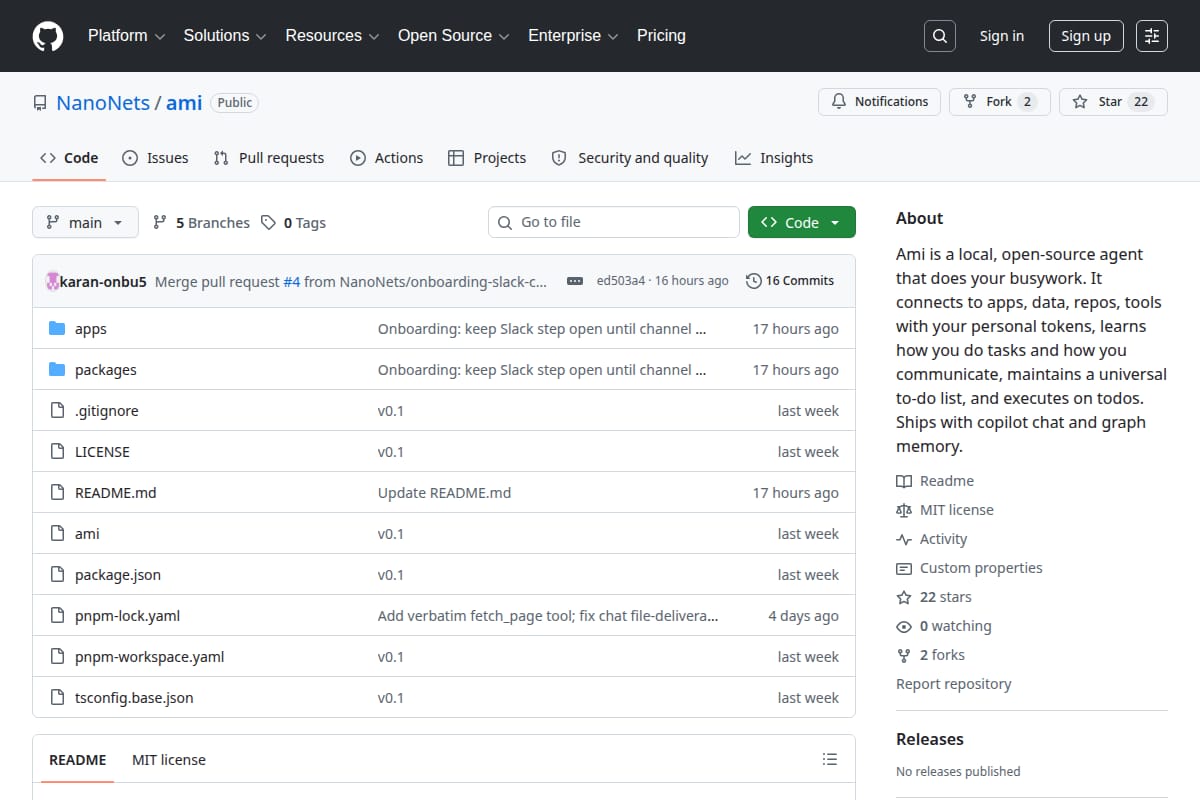
Ami screenshot
#107 Ami
89

AI Agent / Personal Productivity

Ami is a local, open-source AI agent that connects to apps and tools with your own tokens, keeps a universal to-do list, and runs busywork on your behalf. It includes copilot chat and graph memory, and runs on your machine with local data storage.

Thio's Universal Agent screenshot

AI Agent / Computer Use / Desktop Automation

A Windows desktop agent that lets AI interact with any app through visual GUI control, with a portable single-EXE build and support for ChatGPT, Gemini, and Claude.

Hestia screenshot
#688 Hestia
85

AI Agent / Home Assistant

A local-first, self-hosted home assistant that runs a local LLM as a single brain for Home Assistant, voice, memory, reminders, media control, and other scoped tools.

Autodidact screenshot
#961 Autodidact
84

AI Agent / Self-improving assistant

Open-source local-first AI agent that routes between local and cloud LLMs, learns from escalations, and stores knowledge for future queries. The repo includes a quickstart, setup modes, and a concrete explanation of how it ingests docs and improves over time.