AI Research / LLM Reasoning

LaDiR: Latent Diffusion Enhances LLMs for Text Reasoning

Apple Machine Learning Research paper proposing LaDiR, a reasoning framework that combines a VAE-based latent space with latent diffusion to improve LLM text reasoning and iterative refinement.

Clear26/30
Useful22/30
Specific18/20
Complete12/20
LaDiR: Latent Diffusion Enhances LLMs for Text Reasoning screenshot

Why it was accepted

This is a clearly described AI research page from Apple that presents a concrete method for improving LLM reasoning. The page explains the approach, names the core components, and includes publication context plus benchmark claims, which is enough for a useful public listing.
Weakness

The snapshot does not include the full paper text, code, datasets, or an implementation link, so a visitor cannot tell how to reproduce the method or whether an accompanying repository exists.

Review status

72 days ago #976 ↑ +5

Last evaluated 72 days ago. Current rank #976. Up 5 spots in the rankings.

Score history

78

Related listings

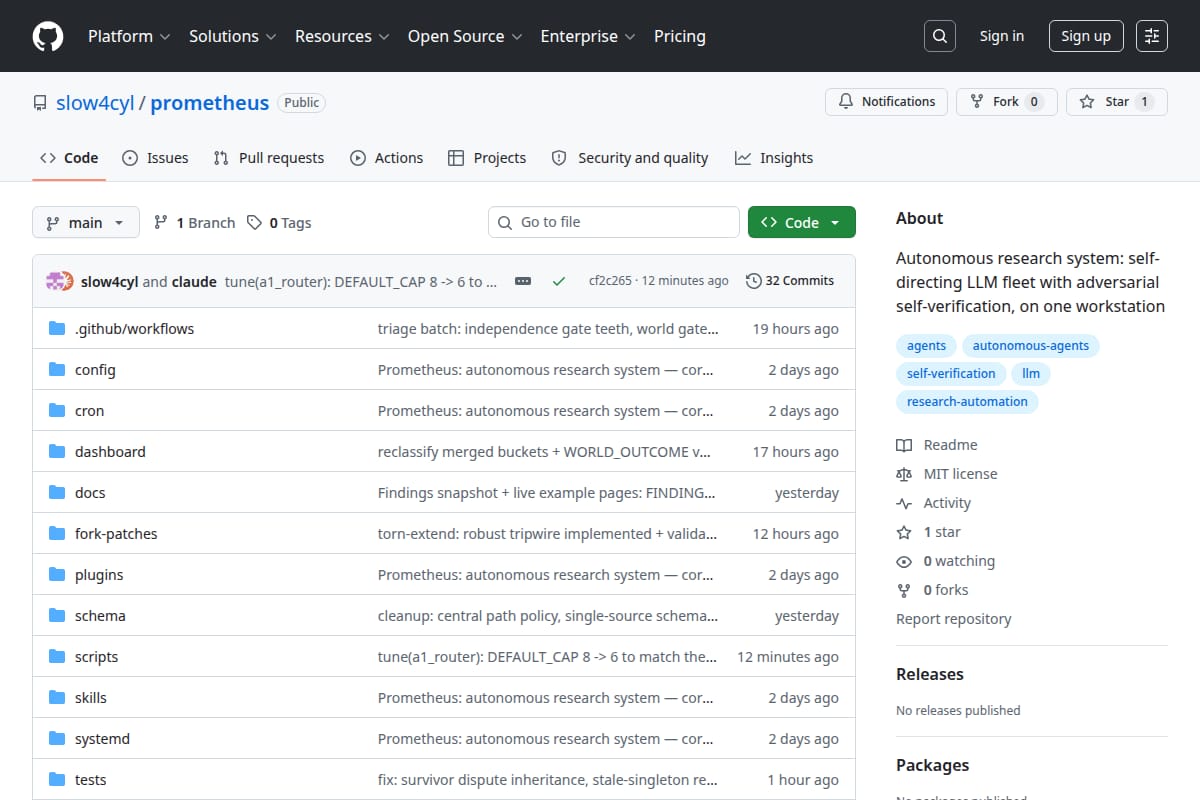
Prometheus screenshot
#263 Prometheus
86

AI Research / Autonomous Research Systems

An autonomous research system that runs on a single workstation and aggressively checks its own claims with adversarial self-verification, replication, and calibration audits.

Socrates screenshot
#733 Socrates
82

AI Research / Multi-agent systems

Open-source multi-agent protocol for AI research agents. It pairs a tool-using Scientist with a question-only advisor that can only ask questions and approve plans, and the README includes quick-start setup plus notes on reproducing results on MLE-bench/Kaggle tasks.

EuroMesh screenshot
#818 EuroMesh
81

AI Research / Analysis / Reports

A sourced model and short report exploring whether Europe could train a sovereign frontier AI model using public compute it already owns, with reproducible code, datasets, and a PDF report.

MarCognity-AI screenshot
81

AI Research / Evaluation / Verification Framework

An open-source research framework for structured LLM evaluation, claim verification, and source-grounded reflective reasoning. The repo describes modular components for retrieval, semantic scoring, skeptical claim checking, and benchmark-style epistemic assessment.