AI Research / Mathematics

Maith

Maith is an open-source research workspace for exploring open mathematics with AI while keeping proof standards explicit and checkable.

Clear27/30
Useful25/30
Specific17/20
Complete8/20
Maith screenshot

Why it was accepted

The page clearly presents an AI-powered product with a focused use case: helping researchers explore open math problems while separating AI-generated ideas from verifiable proof. The repository README gives enough detail for a public listing, including the project’s purpose, workflow, and examples of how AI should be used and checked in mathematical research.
Weakness

The crawl shows the concept and workflow, but not the actual app experience, installation steps, supported tools, or whether there are runnable demos and releases.

Review status

3 hours ago #1029 → 0

Last evaluated 3 hours ago. Current rank #1029. Holding steady in the rankings.

Score history

77

Related listings

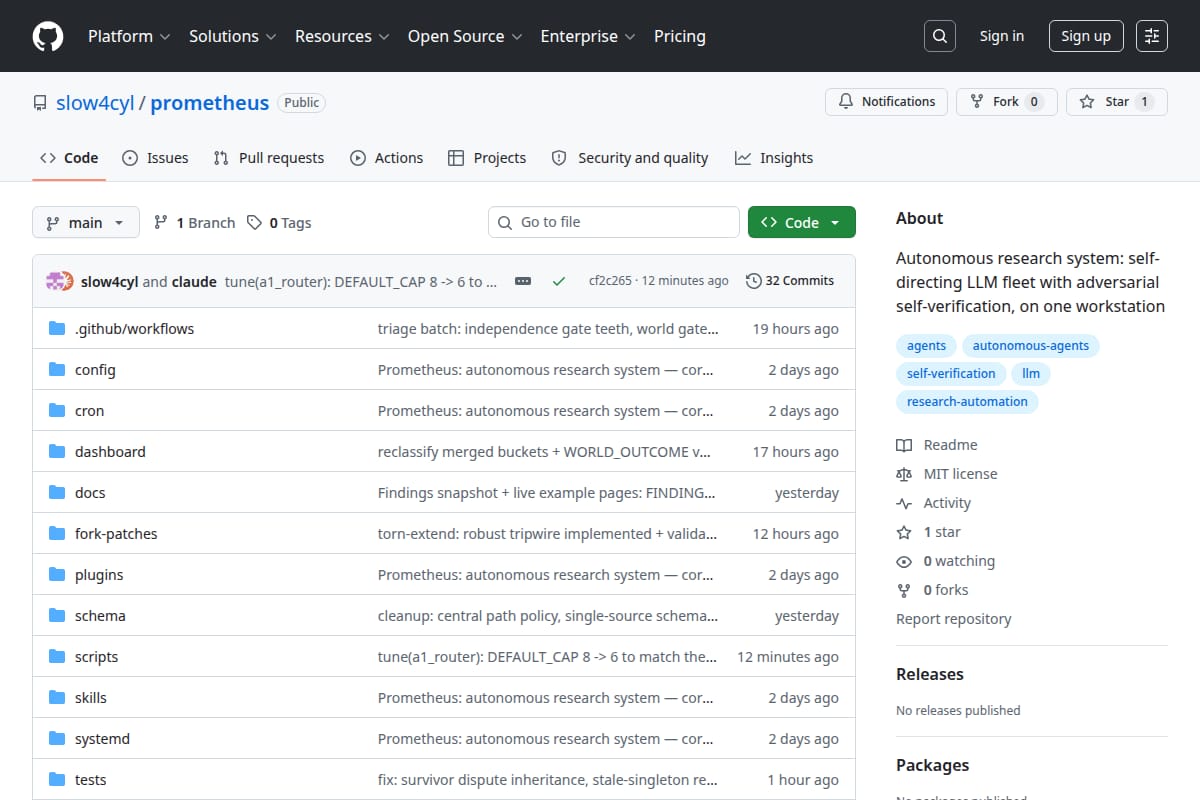
Prometheus screenshot
#276 Prometheus
86

AI Research / Autonomous Research Systems

An autonomous research system that runs on a single workstation and aggressively checks its own claims with adversarial self-verification, replication, and calibration audits.

Socrates screenshot
#767 Socrates
82

AI Research / Multi-agent systems

Open-source multi-agent protocol for AI research agents. It pairs a tool-using Scientist with a question-only advisor that can only ask questions and approve plans, and the README includes quick-start setup plus notes on reproducing results on MLE-bench/Kaggle tasks.

EuroMesh screenshot
#854 EuroMesh
81

AI Research / Analysis / Reports

A sourced model and short report exploring whether Europe could train a sovereign frontier AI model using public compute it already owns, with reproducible code, datasets, and a PDF report.

MarCognity-AI screenshot
81

AI Research / Evaluation / Verification Framework

An open-source research framework for structured LLM evaluation, claim verification, and source-grounded reflective reasoning. The repo describes modular components for retrieval, semantic scoring, skeptical claim checking, and benchmark-style epistemic assessment.